

Essential HR Compliance Checklist Every Employer Should Know (2026 Update)

HR compliance is vital because it establishes fair, safe, and well-structured work environments. Therefore, it is of utmost importance for human resources departments to follow the right HR compliance checklist.
This ensures that all HR activities, including payroll and recruitment, comply with current labor laws and employment regulations. It always supports fair employment practices and a structured work environment.
But what is HR compliance, and what does its checklist cover? You’ll explore everything in this guide.
Key takeaways
- Recruitment, payroll, employee management, and workplace safety are key areas covered in the HR compliance checklist.
- HR professionals must review compliance regularly to stay up to date with changing labor laws and regulations.
- Maintaining accurate employee records and documentation is important for audit and inspection purposes.
- Proper HR compliance reporting reduces the risk of legal penalties and employee disputes.
- Using HR software, businesses can improve accuracy and reduce administrative tasks by automating compliance tasks.
What is HR compliance?
HR compliance refers to creating and updating the company’s policies to align with labor and employment laws and regulations. The human resource department is solely responsible for staying compliant with the latest laws and HR regulations.
Proper maintenance of these compliance requirements protects employees’ rights and creates a healthy working environment. It also prevents heavy penalties.
HR compliance requirements involve maintaining the lawful practices in the following areas:
- Recruitment and hiring
- Employment classification
- Employee record keeping
- Workplace safety
- Leave and attendance management
- Workforce reporting
- Anti-discrimination laws
- Payroll and tax regulations
- Data privacy and security
- Training
Overview of Key HR Compliance Requirements
| Compliance category | Compliance requirement | Review frequency |
|---|---|---|
| Recruitment & hiring compliance | Equal Employment Opportunity (EEO) Compliance | Annually or semi-annually |
| Form I-9 compliance | Annually | |
| Pre-employment screening | Annually | |
| Employee classification | Quarterly or Annually | |
| Employment & workforce compliance | Title VII compliance | Quarterly, Semi-Annually or Annually |
| Fair Labor Standards Act (FLSA) | Quarterly or Annually | |
| Section 503 of the Rehabilitation Act Compliance | Annually | |
| VEVRAA compliance | Quarterly or Annually | |
| Age Discrimination in Employment Act (ADEA) | Annually | |
| Family and Medical Leave Act (FMLA) | Quarterly or Annually | |
| Americans with Disabilities Act (ADA) | Monthly or Quarterly | |
| Affordable Care Act (ACA) | Monthly, Quarterly or Annually | |
| Payroll & employee compensation compliance | Monthly, Quarterly or Annually | |
| Equal Pay Act | Quarterly or Annually | |
| Consolidated Omnibus Budget Reconciliation Act (COBRA) | Monthly, Quarterly or Annually | |
| Workforce safety compliance | VETS-4212 reporting | Quarterly or Annually |
| EEO-1 reporting | Quarterly or Annually | |
| Data privacy compliance | Data privacy compliance | Quarterly or Annually |
HR compliance checklist that you must follow
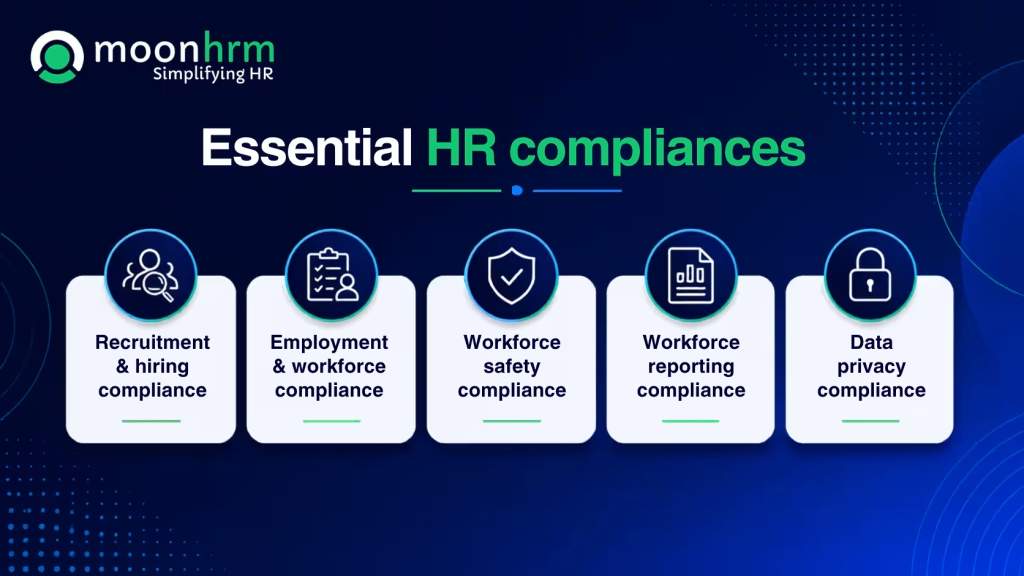
There are certain federal laws and regulations set by the U.S. Department of Labor. Some of the human resource compliance checklists are as follows:
Recruitment and hiring compliance
These compliances are associated with the recruitment and hiring process. HR professionals must comply with these regulations when hiring candidates. The following are the major compliances under this category:
Equal Employment Opportunity (EEO) compliance
This compliance refers to equal treatment of the candidates during job posting and interviews. It means there is no discrimination based on religion, national origin, race, or gender. This applies to recruitment and the entire employment relationship. It supports fair hiring practices and labor law compliance.
Form I-9 compliance
In the U.S., employers use Form I-9 (Employment Eligibility Verification) to verify the identity of hired candidates. The HR team needs to complete and record this form in the defined timeframe. Moreover, organizations must retain this form and its details as mandated by law.
Pre-employment screening
This compliance is closely related to background checks for candidates during the hiring process. The major areas of inspection are candidates’ qualifications, work history, and criminal records. It helps employers to make informed decisions and maintain a safe working environment.
Employee classification
Classify employees on the basis of their designation, job responsibilities, and salary structure. Full-time, part-time, exempt, non-exempt, or temporary employment are such classifications. Organizations can avoid compliance issues through this categorization.
Employment & workforce compliance
Workplace legal compliance refers to adhering to employment regulations governing the employer-employee relationship. The following are the major compliances under this category:
Title VII compliance
Title VII compliance prohibits discrimination against job applicants and employees. These compliance measures are applied to various HR activities, such as recruitment, payroll, and promotion.
Fair Labor Standards Act (FLSA)
The FLSA establishes regulations governing various employment practices. The rules establish minimum wages, child labor standards, and recordkeeping. Any business must comply with these requirements to avoid legal issues.
Section 503 of the Rehabilitation Act Compliance
The U.S. Department of Labor OFCCP enforces this compliance requirement. It refers to the federal regulations that prohibit employment discrimination against disabled individuals. It primarily applies to federal contractors and subcontractors.
VEVRAA compliance
It stands for the Vietnam Era Veterans’ Readjustment Assistance Act. This federal law concerns veteran hiring and promotion. Under it, contractors and subcontractors are obligated to give equal opportunity to protected veterans.
Age Discrimination in Employment Act (ADEA)
This compliance applies to the local, state, and private organizations (with 20+ employees). This compliance aims to protect employees aged 40 or older against age discrimination. It applies to various employment practices, such as hiring, compensation, and layoffs.
Family and Medical Leave Act (FMLA)
Under the FMLA, employees are eligible to take unpaid or job-protected leave for themselves or their family members. Companies need to accept and manage such medical leave to ensure workers’ health remains at a high standard. The HR team must establish clear employee policies for such leaves and maintain related records.
Americans with Disabilities Act (ADA)
ADA compliance is meant to protect the rights of disabled individuals from discrimination. It ensures that disabled employees receive equal treatment during employment. This act allows them the right to access the facilities provided by the company.
Affordable Care Act (ACA)
This act is applicable to companies with 50+ employees. Employers need to provide affordable health insurance coverage to the eligible employees and their dependents. Additionally, maintaining accurate records to demonstrate compliance with healthcare coverage regulations is also essential.
Payroll & employee compensation compliance
This compliance covers the proper payroll processing, compensation management, and tax deductions. As an employer, you need to ensure that the payment meets the minimum wage requirements. You are also required to maintain accurate records of payments and compensation.
Equal Pay Act
This act strongly encourages maintaining transparency and equality in the payroll. Therefore, it prevents wage discrimination based on gender. The HR team needs to continuously review the salaries to reduce such pay gaps.
Consolidated Omnibus Budget Reconciliation Act (COBRA)
COBRA is a federal law. It allows eligible employees and their dependents to continue their employer-sponsored health insurance coverage at group rates temporarily. It is applicable after certain events such as job loss, reduced working hours, or other qualifying events. This act applies to organizations with 20 or more employees.
Workforce safety compliance
This is an important part of any human resource compliance checklist. It primarily focuses on workforce safety and safe working conditions. The following are the main compliance requirements under it:
OSHA compliance
Under the Occupational Safety and Health Act, employers are required to provide a safe environment for their employees. It prevents workplace hazards and injuries and meets regulatory requirements.
Workers’ compensation insurance
Workers’ Compensation Insurance compliance ensures that employees receive the required benefits for illness or injury sustained during the period of service. It protects both employees and employers from the financial impact of workplace accidents.
Workforce reporting compliance
HR compliance reports help businesses track workforce data. Employers are required to maintain accurate employee records and reports on workers’ wages, working hours, and demographic information:
VETS-4212 reporting
VETS-4212 compliance is a mandatory federal reporting requirement for U.S. federal contractors and subcontractors. Companies holding a federal contract of $150,000 need to report the number of protected veterans they hire each year.
EEO-1 reporting
According to EEO-1 reporting, employers are required to submit workforce demographic data to the U.S. Department of Labor. Additionally, they need to submit information about employees’ job categories, race, ethnicity, and gender. Accurate and timely reporting is essential to avoid potential penalties.
Data privacy compliance
This compliance ensures employers protect employees’ information in accordance with applicable data protection laws and regulations. Businesses can reduce compliance risks and data breaches by implementing strong data protection measures. Also, proper data management gives rise to accurate HR compliance reporting.
The California Consumer Privacy Act (CCPA) and the California Privacy Rights Act (CPRA) are the primary regulations. They protect the personal data of California residents and grant them rights related to their personal information.
What are the new compliance changes?
U.S. compliance standards have been modified in accordance with state and federal laws. Some of the major changes are as follows:
Corporate Transparency Act (CTA): Companies must report and continuously update their Beneficial Ownership Information (BOI) to the Financial Crimes Enforcement Network (FinCEN). The major purpose of CTA is to strengthen anti-money laundering efforts and prevent the misuse of shell companies.
Pay transparency and salary thresholds: The HR team needs to disclose the salary structure in job descriptions or upon request. Also, the salary threshold for overtime pay increased to $58,656 as of January 2025 under the Fair Labor Standards Act (FLSA).
Artificial Intelligence: Employers must comply with California’s Fair Employment and Housing Act (FEHA) regulations on the use of AI in hiring. It limits the use of AI in recruitment and automated scheduling. Companies need to disclose the use of AI in the recruitment process to maintain transparency.
What are the common HR compliance mistakes to avoid?
Businesses often overlook important issues that can lead to legal and financial problems. Some of the HR compliance pitfalls that companies encounter are as follows:
- Misclassification of employees leads to wage and tax violations.
- Not maintaining accurate and proper employee records.
- Following old and outdated policies that do not align with the changing laws.
- Mismanaging employee leave requests under the applicable federal, state, or local law.
- Neglecting OSHA requirements and workplace safety training.
- Late or inaccurate submission of EEO-1, VETS-4212, and payroll tax filing.
- Failure to comply with wage-and-hour laws that give rise to incorrect overtime and minimum wage practices.
- Not giving adequate on-site training to the employee.
- Not reviewing the employee handbook and updating policies in accordance with the new law.
- Ignoring employees’ feedback as part of an employee engagement program.
How does HR software help with compliance?
HR management software such as Moon HRM simplifies HR processes. Designed for the modern business environment, it offers the right solution for managing all HR operations in a single system.
Whether it’s employee record-keeping or work-hour tracking, the platform offers a comprehensive solution. Its centralized approach helps companies systematically manage details of employee information. The time-tracking feature ensures that working hours are recorded correctly, resulting in improved data reliability.
Companies can easily track daily attendance and manage employees’ leaves. Automated tracking eliminates errors and enables the HR team to process payroll accurately.
Overall, Moon HRM helps businesses stay organized with clear records and accurate timekeeping. Business leaders can easily meet regulatory requirements and reduce the risk of compliance-related issues.
Closing remarks
An HR compliance checklist is not just about the rules and regulations. It is a core component that every business must follow to stay ahead of regulatory requirements and avoid costly penalties.
Also, it helps the business build trust with employees, reduce legal risk, and support long-term success. Using employee management software such as Moon HRM, you can simplify compliance efforts, automate the administrative tasks, and create a compliant workplace.
Common queries on the HR compliance checklist
A compliance checklist is a structured list of requirements that help organizations comply with workplace regulations and internal policies. By following these checklists, businesses can reduce legal risk, maintain regulatory compliance, and create a well-compliant workplace.
HR compliance refers to the practices a business must follow to comply with employment laws and regulations. It covers the following HR processes:
- Employee onboarding
- Payroll
- Employees leaves
- Workplace safety
- Data privacy and record keeping
- Termination
HR compliance should be reviewed at least annually. Businesses can also conduct compliance audits quarterly or midyear. Regularly reviewing an HR legal compliance checklist ensures that the company’s policies are aligned with current employment laws and regulations.
HR compliance is important because it helps businesses remain in compliance with employment laws. It helps to protect employees' rights and offer proper employee management. By following it, businesses can create a more productive workplace and support operational stability.
These are the documents that are required for HR compliance:
- Employment applications and offer letters
- Payroll records and tax forms
- Time and attendance records
- Employee identification and eligibility verification documents
- Leave and absence documentation
- Workplace safety and training records
- EEO-1, VETS-4212, and other required compliance reports
- Termination and exit documentation