

How to track and manage employee attendance?

Employee attendance tracking is one of the most important parts of a company’s HR department. It ensures the number of working hours employees are putting in, whether employees are being paid accurately, and that their leave balances are assigned correctly in accordance with the company’s policies.
Irrespective of company size or industry, each company tracks employee attendance in its own way. Some companies use paper timesheets, some use attendance registers, and some use biometric systems or HRMS systems.
So, which attendance tracking method is ideal for you? And what are some of the best ways to track employee attendance?
Let’s find answers to all these questions below.
Key takeaways:
- Recording and monitoring employees’ working hours, breaks, and time off is known as employee attendance tracking.
- Paper timesheets and attendance registers are the oldest methods of tracking employee attendance.
- Biometric systems, RFID cards, and HRM software are the most advanced methods for tracking employee attendance.
- Better workforce management and reduced payroll errors are two of the major benefits of tracking employee attendance.
- Screen tracking, geofencing, and payroll management are must-have features in attendance tracking software.
What is employee attendance tracking?
Employee attendance tracking is the process of recording and monitoring employees’ attendance using software or manual methods. It includes working hours, breaks, shift times, attendance status, overtime, and time off for every employee.
Paper-based registers or spreadsheets are the traditional way of tracking employee attendance, but in recent years, many companies have shifted to automated solutions. Whether it is an SME (Small & Medium Enterprise) or a large-scale enterprise, they prefer to use attendance tracking or HRM software rather than time-consuming paper-based processes.
Employee attendance tracking software generally comes with advanced features such as GPS tracking and biometric integration that give an accurate picture of your employees’ attendance in real time.
How to track employee attendance?
Attendance is tracked for employees to monitor absenteeism in the company. Employees who are frequently absent may affect your organizational growth and ongoing projects.
Here are some of the best ways to track employee attendance and quickly address employee absenteeism.
1. Paper timesheets
It is the traditional method of tracking employee attendance. It is a manual method in which employees record their working hours, arrivals, breaks, departures, and overtime on a paper sheet. Later, HRs, managers, and other senior heads review all those employee attendance records and approve them before using them for payroll calculations.
Even though paper timesheets are inexpensive and easy to implement, they can be time-consuming for mid or large-scale businesses. These are highly prone to incorrect entries and lost records; hence, they are suitable for small businesses with a limited workforce.
2. Attendance registers
Attendance registers are another manual method of tracking employee attendance using physical logbooks. When employees arrive at the office, they sign or mark their presence in the register, and later, employers manage those records.
Before technology, attendance registers were the standard method for tracking employee attendance because they were simple to use and required minimal setup. However, attendance registers become challenging to maintain as the workforce grows. Managing attendance records manually with registers can lead to calculation errors, proxy attendance, and difficulties generating attendance reports.
3. Biometric attendance management systems
Instead of paper-based processes or registers, biometric systems use employees’ physical characteristics, such as fingerprint scans or facial recognition, to record attendance. Employees scan their biometric data when
they arrive or leave the office, and the system automatically records working hours.
Biometric systems improve attendance accuracy by reducing proxy attendance and manual errors. As attendance data is updated automatically, it helps businesses reduce administrative work and maintain reliable records for payroll processing and compliance.
4. RFID/card-based systems
RFID, also known as Radio Frequency Identification, is a card-based attendance management system that helps companies record employee attendance by allowing employees to swipe or tap their ID card at a card reader when arriving or leaving the office. Each card comes with a unique identifier that connects the attendance data to the respective employee.
RFID/card-based systems are far faster than manual or biometric systems. They keep employees’ data organized, and records are stored digitally. Digitization allows HR and managers to monitor employee attendance and generate reports more effectively.
5. HRM Software
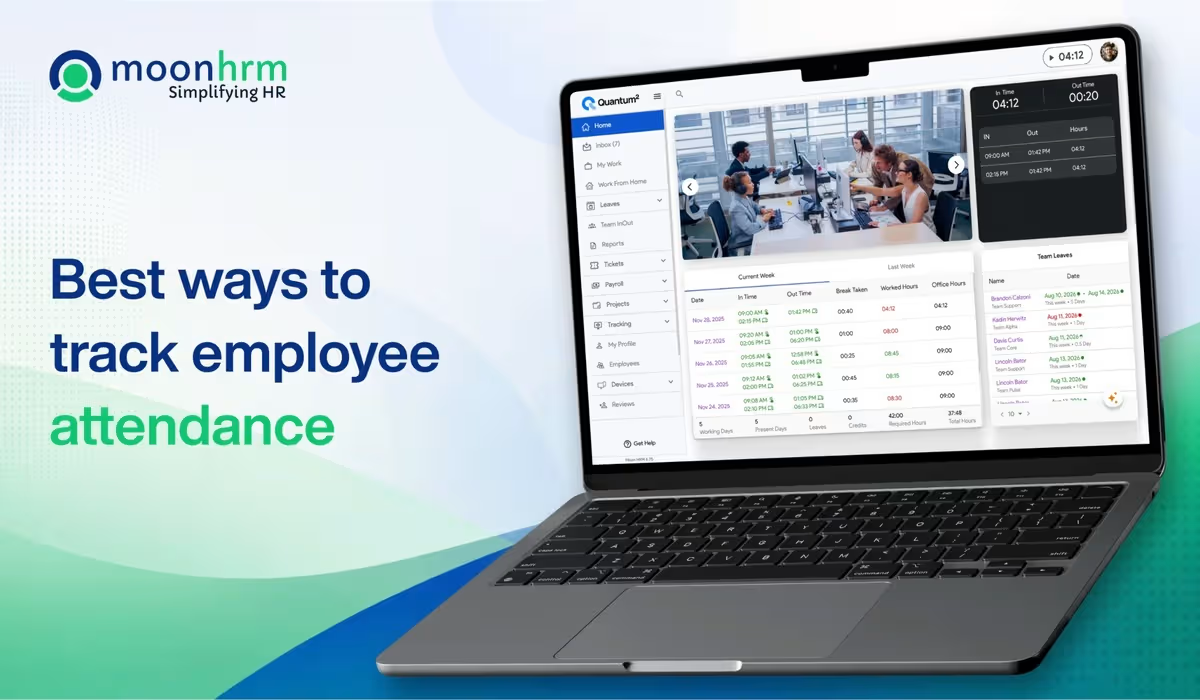
HRM software is the most advanced and currently highly used method for tracking employee attendance. It records employee time or work hours, attendance status, leave, breaks, and shift schedules through multiple ways, including web portals, applications, biometric integrations, and GPS-enabled check-ins.
HRM software makes the entire attendance-tracking process fast and accurate, providing real-time visibility into workforce activities. With HRM software, businesses track attendance, monitor absenteeism trends, manage leave requests, generate reports, and integrate with payroll systems, all in one platform.
Benefits of tracking employee attendance
Employee attendance tracking has multiple benefits that help businesses grow over time. Here are the key benefits you should know:
- Improved employee accountability: Effective attendance tracking systems encourage employees to complete their work schedules and take responsibility for having a clear attendance record.
- Better workforce management: Businesses easily manage shifts, allocate resources, and avoid staffing shortages with the help of employee attendance management systems.
- Accurate leave management: Tracking attendance helps organizations manage leave requests of employees more effectively.
- Reduced payroll errors: Accurate attendance monitoring helps HR teams reduce human errors when calculating employees’ salaries, overtime hours, and leave deductions.
- Strategic decision-making: Tracking employee attendance helps generate reports that identify absenteeism trends, irregularities, and compliance issues. It also helps organizations make strategic decisions for long-term growth.
Features to look for in an attendance tracker software
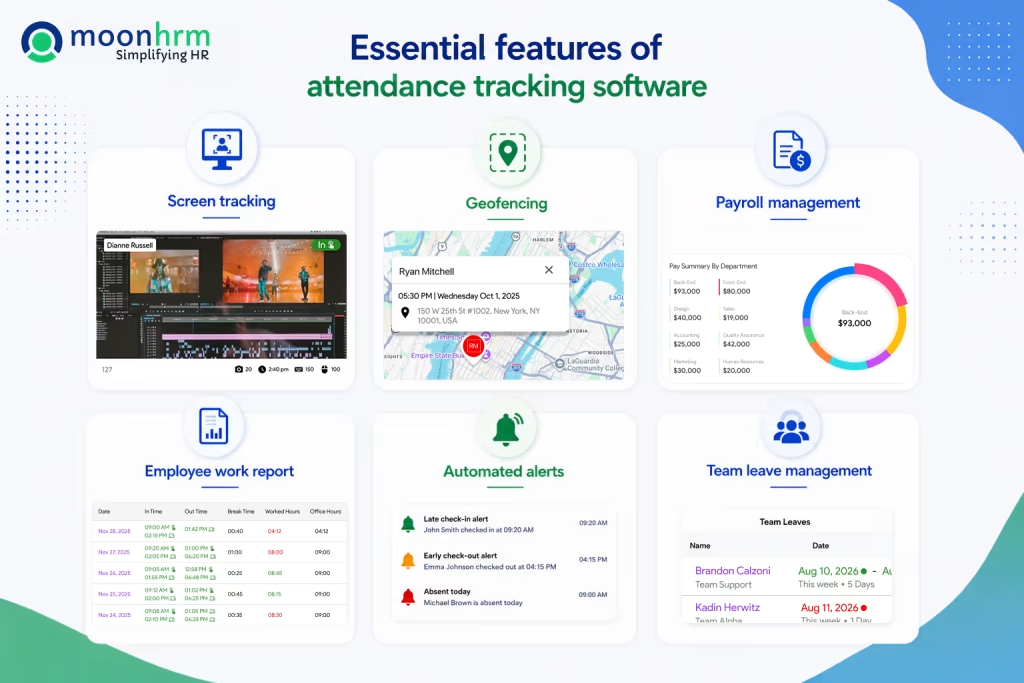
Below are the features you should look for while choosing an employee attendance tracker software:
1. Screen tracking
Screen tracking is an important feature of attendance-tracking software. It allows managers to monitor every employee’s work activities by reviewing screenshots or active screen time during working hours. Due to this screen tracking or capturing feature, businesses can easily understand how work time is utilized. Screen tracking is incredibly useful for remote or hybrid work environments.
2. Geofencing
Geofencing is another must-have feature to look for in attendance tracking software. It is a location-based technology that uses GPS to create a virtual, invisible boundary around your physical workplace. Employees must remain within this virtual boundary to clock in or out in the system; outside it, they won’t be allowed to clock in or out. Geofencing is a must-have in attendance tracking software as it reduces fraudulent activities such as buddy punching.
3. Payroll management
An ideal attendance management system should include a payroll management feature to manage records from a centralized platform. Syncing payroll automatically with employees’ attendance records can make the entire payroll process faster and more accurate. You don’t have to manually check each employee’s leave records and overtime when processing salaries.
4. Employee work report
Now, another feature you should look for is the employee work report. It is a necessary feature because it provides more detailed employee insights, such as time spent on different projects, total worked hours, and other productivity metrics. The employee work report feature helps you evaluate employee performance, identify irregularities, and make decisions that improve the organization’s internal processes.
5. Automated alerts
Sending automated alerts is another crucial feature to consider in attendance tracking software. A feature that keeps both employees and managers informed about important attendance-related events. When employees forget to clock in or are unable to arrive at the office for the day, the software should notify the managers. For leave approval or temporary remote work access, the software should send alerts to employees.
Quick tips to improve employee attendance tracking
If employee attendance tracking keeps you stalled for hours, consider the following tips to improve it.
- Create attendance guidelines that specify the total work hours, break times, leave procedures, and what penalties or consequences could be imposed if the guidelines are not followed.
- Use the right employee attendance monitoring software that comes with advanced automation features instead of using long, time-consuming manual tracking procedures.
- Check attendance reports on a daily or weekly basis to quickly identify absenteeism patterns, frequent absences, and take necessary action.
- Train employees on attendance procedures so that they can easily understand how to mark attendance, request leave, or apply WFH.
- Integrate payroll management with your attendance tracking software so that you can save administrative time and reduce payroll discrepancies.
Track employee attendance seamlessly with Moon HRM
Some years ago, managing attendance records accurately was a tough task for businesses. They used to rely on manual attendance tracking methods to record time, check leave, and process salaries. However, over time, technology has advanced, and almost every business now uses attendance software as part of its workflow.
In today’s world, if you want to build a company, the first thing you need is attendance management software. The reason? Simple: you need to track your employees’ attendance more effectively. The software offers more benefits and features, and is more useful than manual spreadsheets or attendance registers could ever be.
So, are you looking for an HRM software that helps you track employee hours, manage leaves, and process payroll all in one place? You are at the right place.
Get started with Moon HRM today!
Additional questions on employee attendance tracking
To track employee attendance, you should consider using attendance tracking or HRM software in your organization instead of paper-based manual methods. It helps you track employee time, automate attendance workflow, and provide accurate payroll processing without requiring manual data entry.
The most accurate and advanced way to record employee attendance is by using an attendance management system. Using a tracking system reduces manual errors and helps record time and attendance data seamlessly.
The 7-minute rule (also popularly known as quarter-hour rounding) is a FLSA (Fair Labor Standards Act) guideline that allows employers to round non-exempt employees' work hour punches to the nearest 15 minutes. 0 to 7 minutes is considered round down, and 8 to 14 is considered round up.
The easiest way to track employee hours is by using employee attendance tracking software that also offers web sign-in access so that you can access employee data whenever you need. You can use reliable attendance tracker software, such as Moon HRM, in your workflow to seamlessly track and manage your employees' hours.