


HR metrics and HR analytics: what’s the difference, importance, & types

HR metrics and HR analytics play a key role in any organization’s workforce. They provide the data needed to understand how the HR process is progressing and what actions can be taken to improve it.
Thus, both make valuable contributions to the company’s growth by helping professionals to plan, scale operations, and reduce risk.
Despite their significance, the two concepts often cause confusion among professionals. Here, you will find the right guide on the difference between HR metrics and HR analytics.
Key takeaways
- HR metrics track numbers, such as absenteeism and turnover, whereas HR analytics interprets that data to uncover insights.
- HR analytics depends on HR metrics because they provide the data for interpretation.
- Data analytics in HR contributes to an organization’s productivity and growth.
- Using metrics and analytics together improves business performance across recruitment, employee retention, and overall productivity.
- Business professionals can streamline their HR metrics and analytics using HRM software.
What are HR metrics?
HR metrics are measurable data used to track and measure the effectiveness of human resource activities within an organization. Recruitment, employee performance, productivity, engagement, and retention are the key measurable areas.
In other words, human resources metrics are the numbers that represent your employees and the performance of your human resource activities. Turnover rate and employee productivity are some essential HR metrics to track in the business world.
What are HR analytics?
HR analytics involves collecting and analyzing employee data to make informed decisions that refine the overall human resources process. It is also known as workforce analytics or people analytics.
Data analytics in HR transforms the raw data into meaningful insights to improve decision-making. It helps to understand patterns, predict outcomes, and improve overall workforce performance.
What is the key difference between HR metrics and analytics?
The major difference between HR analytics and metrics lies in their scope and application within human resource operations.
In simple terms, HR metrics are the measurable data the HR department uses to track, assess, and evaluate. HR analytics, on the other hand, refers to the collection and interpretation of data.
HR Metrics vs HR Analytics
| Aspects | HR metrics | HR analytics |
|---|---|---|
| Definition | Measures HR-related data. | Analyze the data to generate insights. |
| Focus | Its major focus is to track performance. | The main aim is to understand and improve performance. |
| Nature | The nature of this metric is descriptive. | The nature of HR analytics is diagnostic, predictive, and prescriptive. |
| Purpose | Its main purpose is to monitor HR activities. | It supports decision-making. |
| Outcome | These are reports and dashboards. | These are actionable insights and strategies. |
How are HR metrics and analytics interconnected?
HR metrics and HR analytics are two distinct concepts, but they are related. As HR metrics collect data, they establish a baseline for analytics to interpret.
In the absence of key metrics such as turnover rate and absenteeism, it is not possible to interpret and analyze performance. It becomes difficult to find trends.
In simple terms, metrics tell what is happening, and analytics tell why it is happening and what to do next.
Why HR metrics are important?
Human resource metrics data are essential for the organization, helping enhance its HR performance. Here are the key points showing the value of HR metrics:
Managing talents effectively
HR metrics help track and analyze talent acquisition activities. The HR department can manage talent more efficiently and make related decisions more effectively.
Improving cost control
HR metrics data enable human resources to allocate and manage budgets efficiently. Professionals can make a fair justification for the investment they make in employee training and development programs. Additionally, it is also easy to predict ROI.
Making better decisions
HR metrics provide clear insights into many HR actions. Using this data, professionals can identify cost-saving opportunities and the root causes of lower employee engagement and retention. This helps them to make informed decisions.
Stronger strategic planning
Every organization needs strategic planning and goals to achieve success. HR metrics simplify it, enabling the prediction of trends and other insights that help the team align with business plans.
Why HR analytics are important?
Companies can achieve significant transformation through HR analytics and reporting. Here are the key reasons why these analytics are important:
Enhancing the recruitment process
Human resources can gain insights from data and predict employees’ satisfaction levels. Ultimately, they take the required actions when outcomes do not meet expectations. Overall, HR analytics refines the human resource recruitment process.
Strengthening employee development
By leveraging HR analytics, organizations can identify gaps that hinder employees’ growth. Leaders can analyze and monitor employees’ performance. This allows them to take the necessary action, such as conducting training that benefits both employees and employers.
Reducing the cost
Human resource analytics helps reduce onboarding costs through understanding the causes of employee turnover. Also, management can distribute work more efficiently by analyzing the highlighted trends over time. They can reduce extra payroll expenses by improving resource utilization.
Align HR with the business goals
HR roles and responsibilities become more closely aligned with business growth through HR analytics. HR managers can set Key Performance Indicators (KPIs) using HR analytics and reporting to gain insights from real data. This motivates them to keep aligning with the business goals.
Types of HR metrics and analytics
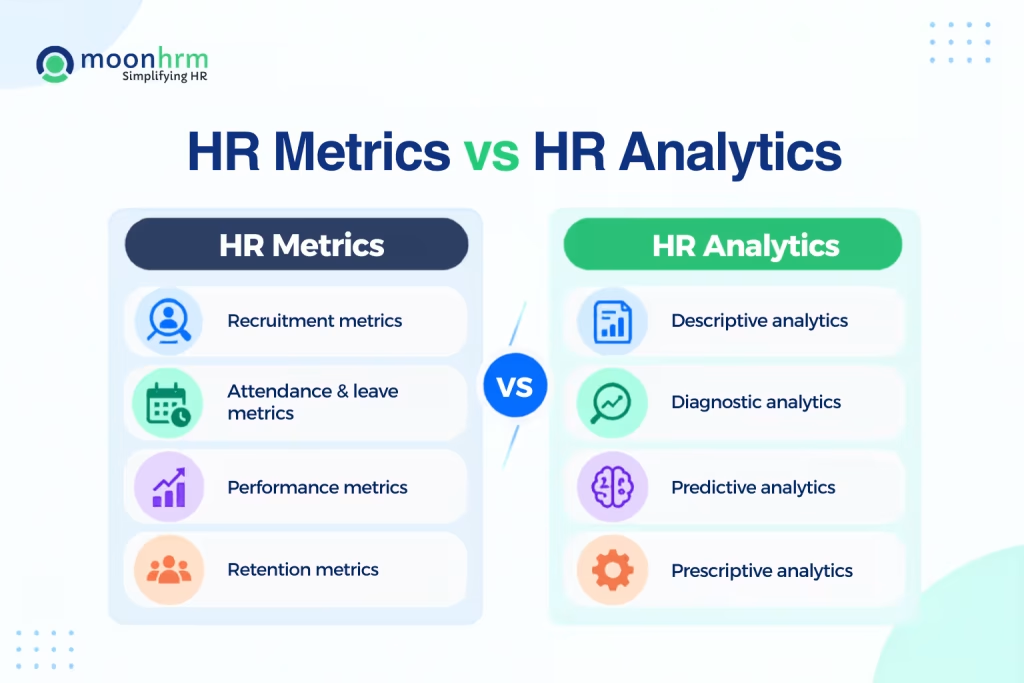
HR metrics and analytics are classified into different categories, which are as follows:
Human Resource Metrics
1. Recruitment metrics
These data points reflect the effectiveness and efficiency of the hiring process. They enable improvements to the recruitment process while reducing costs. This is one of the important HR metrics to track. Some of these metrics are:
- Cost per hire
- Time to hire
- Quality of hire
2. Attendance & leave metrics
These HR indicators track the employees’ attendance and time off. They help manage and reduce employee burnout and enhance productivity. The main metrics are:
- Absenteeism rate
- Overtime hours
- Leave utilization rate
3. Performance metrics
HR performance metrics are measurable data that help evaluate employee performance and the company’s growth. They help determine the level of productivity the organization is achieving. Some of these metrics are:
- KPI achievement rate
- Punctuality rate
- Leave frequency
4. Training & development metrics
These metrics help measure the effectiveness of employees’ training and development. Some of these metrics are:
- Training attendance rate
- Productivity improvement
- Skill improvement rate
5. Retention metrics
These metrics demonstrate the company’s ability to retain its employees. Leaders use these HR metrics to track key areas for improving employee tenure. These metrics include:
- Turnover rate
- Average employee tenure
- Retention rate
6. Engagement metrics
These parameters help determine employee engagement with the organization. The HR department can use these standards to motivate employees and better understand their emotional connection to the workplace.
- Engagement score
- Participation rate
7. Compensation & cost metrics
This is one of the most important HR metrics. These standards involve measuring the company’s employee spending and understanding how workforce-related costs support the company’s growth. The key metrics are:
- Total payroll cost
- Overtime cost
- Hiring cost
Human Resource Analytics
There are generally four types of HR analytics, each with its own purpose.
1. Descriptive analytics
This is one of the most basic types of analytics, relying on past data to understand trends. Professionals can generate reports that summarize historical records.
2. Diagnostic analytics
Business professionals use this analytics to find the root causes of the trend. It explains why it is happening by analyzing historical data, trends, and patterns.
3. Predictive analytics
Business professionals use this analytics to predict future outcomes through the historical data. Its core explanation is what is likely to happen.
4. Prescriptive analytics
It suggests actions based on data insights and also supports decision-making. Thus, it implies what actions to take.
How to turn HR metrics into HR analytics?
Data gathering alone is not enough to implement HR analytics. Here is the right approach:
Set objectives and collect relevant data
Analyze the HR infrastructure to identify the key challenges, such as low productivity or high turnover. This will help to set clear objectives while finding the solution. Later, proceed with data collection. Ensure the accuracy, consistency, and completeness of the data collected from multiple sources.
Segment the HR metrics
It is pointless to focus on every data point in HR metrics because not all are important. Choose and prioritize only the ones that are most relevant to your business goals. You can use HR analytics tools that offer advanced capabilities.
Identify the trends and make decisions
Start by analyzing the data through an HR analytics tool. This helps HR find why something is happening, rather than just what is happening. HR departments can later outline their strategies based on these insights to address challenges in advance.
Continuous monitoring
Just one-time data collection and analysis are not enough. It is a continuous journey, and you need to regularly review the metrics and run analytics.
Link analytics to business impact
It is essential to improve business results across cost, profit, growth, and client satisfaction. To achieve this, you need to turn the data insights into measurable improvements.
Streamline human resource management with Moon HRM
Moon HRM is a single solution to streamline HR management. Businesses can manage employee attendance, leave, payroll, and performance data on a single platform.
The human resources team can track employees’ daily attendance through the robust leave and attendance feature. They can also report late arrivals. Employees can request half-day or full-day leave, and managers are eligible to approve or reject it.
It offers biometric access tracking, enabling businesses to monitor employees’ working hours via an integrated system. It also generates automated attendance reports. This provides accurate data for measuring attendance patterns and working hours.
Organizations can easily track and manage employees’ leave, including paid, medical, and other emergency leave. The system enables the HR team to improve payroll accuracy through clear records of employees’ attendance and leave.
Employees can submit daily work reports. This allows managers to track staff working, streamlining overall workforce management easily. They can evaluate work productivity and take informed workforce decisions.
Overall, Moon HRM reduces manual data collection and provides accurate workforce data. Thus, organizations can turn HR data into actionable insights and take informed decisions.
Last remarks
HR metrics and HR analytics are two important concepts that together form the foundation of data-driven HR management. You can gain meaningful data from metrics to assess workforce performance, while analytics help transform that data into actionable insights. By using reputable software such as Moon HRM, you can align HR initiatives with overall business goals and drive decision-making.
Want to see how it works? Schedule your demo today.
FAQs
HR metrics offer a snapshot of HR's overall performance. They offer key, measurable, and trackable metrics, such as time-to-hire and employee turnover. HR analytics, on the other hand, supports data-driven decision-making by uncovering insights through data analysis and interpretation.
The four types of HR analytics are as follows:
- Descriptive analytics
- Diagnostic analytics
- Predictive analytics
- Prescriptive analytics
To prepare the HR metrics, you need to define the business goals and later on choose the HR areas that need improvement. These areas can be recruitment, payroll, or performance. Choose key metrics aligned with these goals and set clear benchmarks for each. Finally, monitor the metrics to make better decisions.
HR metrics are measurable data points that evaluate daily HR activities and outputs. It primarily focuses on employee attendance, payroll, and recruitment processes. HR KPIs (Key Performance Indicators) primarily focus on HR goals and define how HR contributes to the organization's growth.
The best HRM tool depends on the company’s size and requirements. However, an ideal HRM tool must include attendance and leave management, payroll, and time tracking. Moon HRM offers all these features in one centralized location with a simple, user-friendly layout. It allows for managing employee records, leave, and attendance, as well as monitoring both on-site and remote work. Overall, it offers one-to-one HR solutions, enhances accuracy, and saves time.